Skip to content
Red Hub – Business Ideas and Opportunities
Introduction to Business Ideas and Opportunities
CHAPTER 1: GENERATION OF BUSINESS IDEAS
Chapter Outcomes
1.1 Role of ideas
1.2. Business ideas and creativity
1.3 Generating business ideas
Collapse
1.3 Generating business ideas
6 Topics
1.3.1 Generation of ideas from the entrepreneur’s skills, expertise and aptitudes
1.3.2 Generation of ideas from common needs
1.3.3 Generation of ideas from existing problems
1.3.4 Generation of ideas from everyday activities
1.3.5 Generation of ideas from other sources
1.3.6 Generation of ideas through brainstorming

1.4. Ideas you can think about
1.5. Important points regarding business ideas
1.6 CONCLUSION
Expand
1.6 CONCLUSION
1 Quiz
Self-Assessment Questions
CHAPTER 2: SCREENING TECHNIQUES FOR BUSINESS OPPORTUNITIES
Chapter Outcomes
2.1 Introduction
2.2. Ideas versus Opportunities
2.3 Characteristics of an opportunity
2.4 Where to look for opportunities
2.5 Evaluating business opportunities using screening techniques
Expand
2.5 Evaluating business opportunities using screening techniques
8 Topics
|
1 Quiz
2.5.1 Market issues
2.5.2 The competitive situation
2.5.3 Economics
2.5.4 Harvest issues
2.5.5 Management team issues
2.5.6 Fatal flaws
2.5.7 Personal criteria
2.5.8 Other strategic criteria
Self-Assessment Questions
CHAPTER 3: FEASIBILITY AND VIABILITY STUDIES
Chapter Outcomes
3.1 Introduction
3.2 The development of your small business idea
3.3 Conclusion
Expand
3.3 Conclusion
1 Quiz
Self-Assessment Questions
Previous Topic
Next Lesson
1.3.6 Generation of ideas through brainstorming
Red Hub – Business Ideas and Opportunities
1.3 Generating business ideas
1.3.6 Generation of ideas through brainstorming
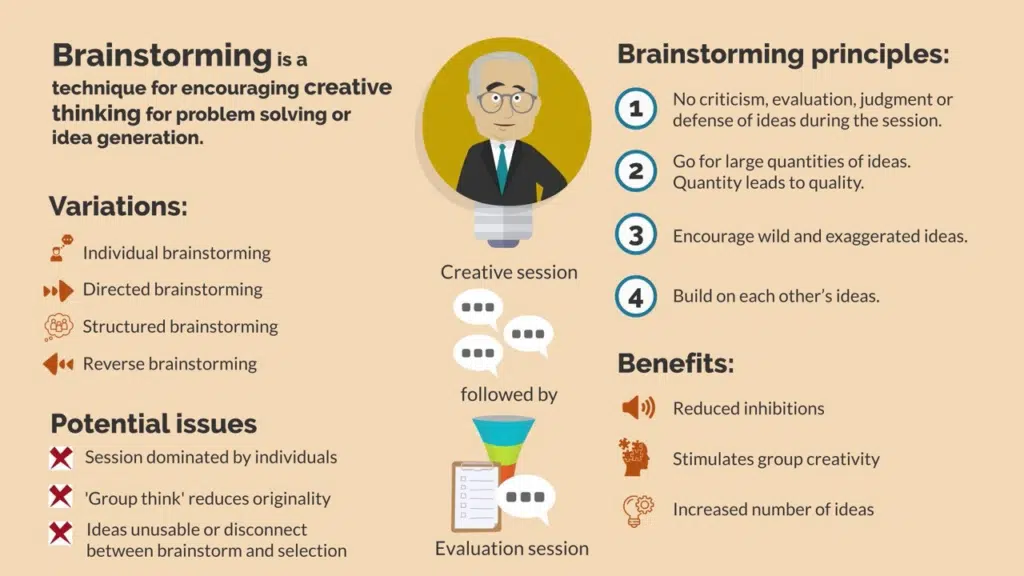
Business ideas can also be generated through brainstorming. Timmons (1999) offers the following ten brainstorming rules:
Define your purpose
Record ideas in full
Choose participants
Invent as much as you can
Choose a facilitator
Resist becoming committed to one idea
Brainstorm spontaneously, copiously
Identify the most promising ideas
No criticism, no negatives
Refine and prioritise
Remember, the quickest way to kill an idea, according to Schenck (2005), is to say something like:
It won’t work.
We’re not ready for that.
It isn’t practical.
It’s already been done.
That’s just plain stupid.
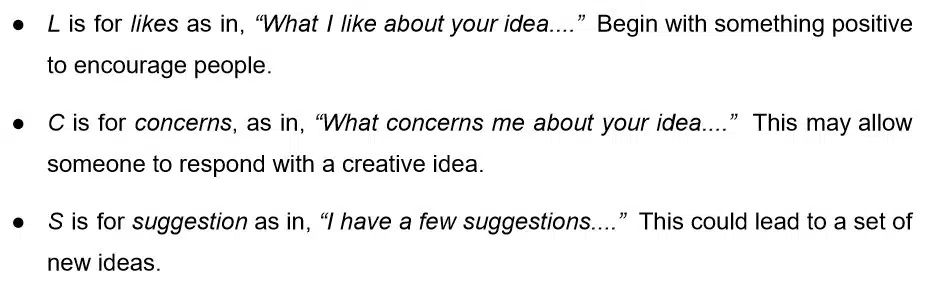
You could even arrange a brainstorming session with people you trust. When one is given an idea one needs to apply the LCS system:
Tasks
Watch the following video for a more detailed explanation on how business ideas are generated:
Previous Topic
Back to Lesson
Next Lesson
1.3.6 Generation of ideas through brainstorming