Skip to content
Red Hub – Business Ideas and Opportunities
Introduction to Business Ideas and Opportunities
CHAPTER 1: GENERATION OF BUSINESS IDEAS
Chapter Outcomes
1.1 Role of ideas
1.2. Business ideas and creativity
1.3 Generating business ideas
Expand
1.3 Generating business ideas
6 Topics
1.3.1 Generation of ideas from the entrepreneur’s skills, expertise and aptitudes
1.3.2 Generation of ideas from common needs
1.3.3 Generation of ideas from existing problems
1.3.4 Generation of ideas from everyday activities
1.3.5 Generation of ideas from other sources
1.3.6 Generation of ideas through brainstorming
1.4. Ideas you can think about
1.5. Important points regarding business ideas
1.6 CONCLUSION
Expand
1.6 CONCLUSION
1 Quiz
Self-Assessment Questions
CHAPTER 2: SCREENING TECHNIQUES FOR BUSINESS OPPORTUNITIES
Chapter Outcomes
2.1 Introduction
2.2. Ideas versus Opportunities
2.3 Characteristics of an opportunity
2.4 Where to look for opportunities
2.5 Evaluating business opportunities using screening techniques
Expand
2.5 Evaluating business opportunities using screening techniques
8 Topics
|
1 Quiz
2.5.1 Market issues
2.5.2 The competitive situation
2.5.3 Economics
2.5.4 Harvest issues
2.5.5 Management team issues
2.5.6 Fatal flaws
2.5.7 Personal criteria
2.5.8 Other strategic criteria
Self-Assessment Questions
CHAPTER 3: FEASIBILITY AND VIABILITY STUDIES
Chapter Outcomes
3.1 Introduction
3.2 The development of your small business idea
3.3 Conclusion
Expand
3.3 Conclusion
1 Quiz
Self-Assessment Questions
Previous Lesson
Next Lesson
3.2 The development of your small business idea
Red Hub – Business Ideas and Opportunities
3.2 The development of your small business idea
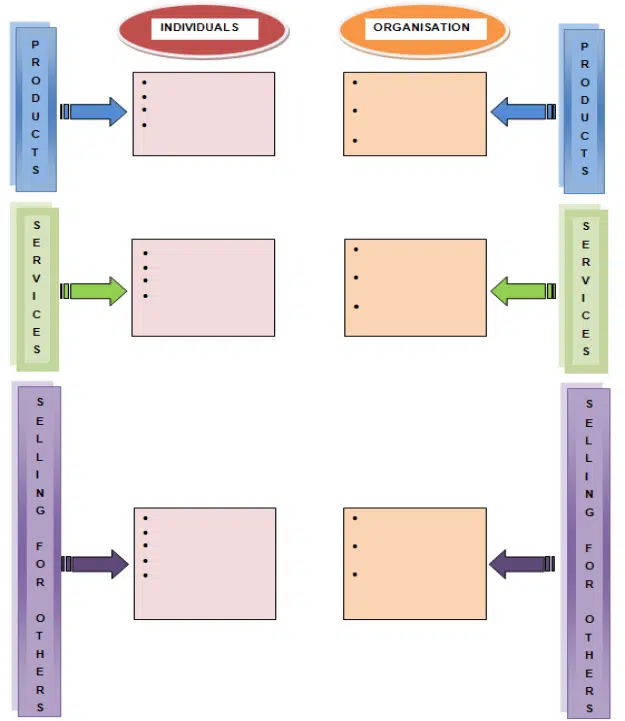
The bow-tie diagram in Learning Activity 2h above can also be used to develop your small business idea in terms of the:
Essence of the idea
Possible combination of ideas
Taking a new direction with the idea
Suppose we take the idea “to bake cakes”. In the following diagram you can see all the ideas that might emerge from this one.
Feasibility of the business idea
Take one of the ideas that you listed in Chapter 1 and use the bow-tie diagram below to develop this idea further.
Tasks
Watch this video for more insight to why feasibility analysis are conducted on business ideas:
To determine whether your small business idea is feasible, you must be able to answer the following four questions satisfactorily:
Do you want to do what the idea suggests?
Is there a market for your idea?
Can you meet the needs of your consumers?
Can you get the idea to the consumers?
Previous Lesson
Back to Course
Next Lesson
3.2 The development of your small business idea